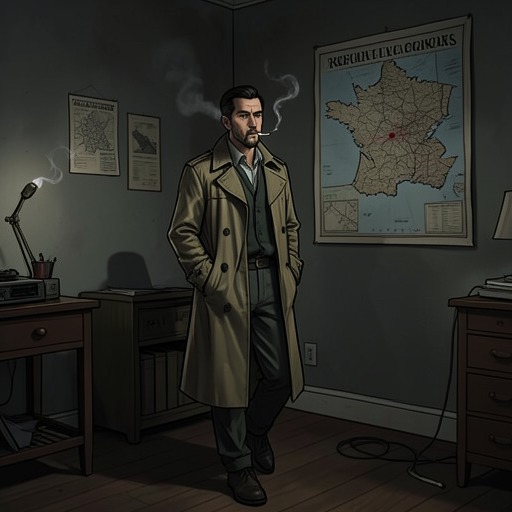
Fort d'Ivry
The Day of the JackalFort d'Ivry is a military prison outside Paris whose courtyard becomes the novel’s opening scene: the place where Lieutenant-Colonel Jean-Marie Bastien-Thiry is executed by firing squad on March 11, 1963. The scene gives the fort a decisive narrative significance, presenting an apparent end to attacks on Charles de Gaulle that the book immediately recasts as the beginning of another story.
Setting and the Courtyard
The execution takes place at 6:40 in the morning in the fort’s main courtyard. Bastien-Thiry stands bound to a stake driven into the gravel, facing the soldiers from twenty metres away. The March cold makes the setting feel harsher still; before the firing, a priest murmurs beside him and a foot scuffs the grit, a small sound that briefly releases the tension.
The fort’s walls separate the execution from the waking city without sealing it off from ordinary life. A Berliet truck blares outside as a smaller vehicle crosses its path. The traffic noise masks the order to aim, then rises again after the shots. Pigeons flutter skyward, while the later coup de grâce is lost in the sound of the city. The scene makes the courtyard a bounded place where a state execution unfolds amid sounds that continue beyond its walls.
Bastien-Thiry's Execution
Bastien-Thiry, a French Air Force lieutenant-colonel, is executed as the leader of a group of Secret Army Organisation killers who had sought to shoot the President of France. His hands are tied behind the post, and a blindfold is wrapped over his eyes before the firing squad raises and cocks its rifles. The rifles fire; seconds later, an officer delivers the coup de grâce.
The account lingers on the sequence of gestures and sounds rather than treating the execution as a bare report. The blindfold extinguishes the last light available to Bastien-Thiry; the priest’s mumbling is set against the crackle of twenty rifle bolts. Outside, the traffic does not stop. That contrast places the violence within the routine flow of the city, even as the courtyard contains the final moments of a man condemned for his role in an attack on the President.
Political Context and Narrative Reversal
The execution is presented as an intended ending: Bastien-Thiry’s death is supposed to put a stop to further attempts on the President’s life. The novel overturns that expectation. By a reversal described as a quirk of fate, the death marks a beginning instead, and the narrative turns back to explain how another threat came about.
That explanation reaches back to August 22, 1962, when men waiting beyond Paris had decided that Charles de Gaulle should die. The movement from the March 1963 execution to that earlier date makes Fort d'Ivry a framing point rather than the site of the plot’s later pursuit. Its opening scene establishes the consequence of one failed campaign while preparing the reader for the renewed danger that follows.
Narrative Significance
Fort d'Ivry concentrates the book’s tension between apparent closure and continuing political violence. The execution seems to settle the immediate matter: the leader of the killers is dead, and the state has answered an attempt on the President. Yet the narrative identifies that seeming resolution as a false endpoint. The fort’s courtyard therefore functions as the threshold of the story: a place where an ending is enacted, only for the book to disclose that the threat has not ended with it.